Nagarjuna Institute
This is a restored version of the original site, archived as reading material for Dr. Brett Ji's seminar Religion III : Buddhism. Restoration and development credits go to TNG/Earthling's Rev Sale and Bob Sakayama. Translations and research by Raga Shim. Students are invited to download the full reading list from the religion department's webpage or from the course listing. Dr. Ji has authored a number of English language articles in Religion Today and is considered an expert on Eastern religions. He is Bryce Watson Fellow and serves on the board of Truce Divinity.
Welcome to Nagarjuna Institute's Website
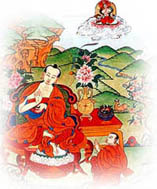
Established in March 1980, Nagarjuna Institute of Exact Methods is a center of Buddhist Learning, which serves the needs of the Buddhist community in the Kathmandu valley. It aims at enlightening Nepalese people about their own form of Buddhism, its philosophy and practice. Nepalese Buddhism is a unique tradition in itself. The nature of this tradition was observed centuries ago in Nalanda and Vikramasila Universities. For reinstatement of the glorious traditions and lineage of Nepalese Buddhism.
This was their website. Content is from the site's 2006 archived pages.
Sanskrit Buddhist Input Project
Nagarjuna Institute has initiated the digitization of extant published Sanskrit Buddhist Canon available to date on collaboration with the University of the West, USA.
Mailing List : Sanskrit Buddhism
This group focuses discussion on the subject of the Sanskrit Buddhist literature found in Nepal and that literature published or yet to be published in other countries. Scholars can post any information on dissertations, publication of new Sanskrit Buddhist texts or translations, editions or library collections of Sanskrit Buddhist texts in one's academic institution.
Buddhist News and Updates
1. Special intensive class on Tibetan Buddhism and Iconography
2. The English Translation of Svayambhu Mahacaitya released....
3. Buddhist Sites Update:
Four Karunamayas of the Kathmandu Valley
Contact Information
Mr. Min Bahadur Shakya
Director
Nagarjuna Institute of Exact Methods
(A Center for Buddhist Studies)
Chakupat, Lalitpur, Nepal
P.O.Box 100, Tel: 977-1-5520558, Fax: 977-1-5527446
Email : niem@wlink.com.np
 Newar Buddhism: Problems and Possibilities
By: Mr. Min Bahadur Shakya
OVER THE LAST FEW DECADES, the Kathmandu valley has become the meeting place of Tibetan and Western Buddhists for the study of Buddhism. Renowned Tibetan Buddhist masters are busy offering initiations, conducting seminars and teaching sessions. Serious Western Dharma practitioners participating in these initiations and seminars seem to be less aware of the existence of a strong Buddhist tradition practised by the Newars of the Kathmandu Valley. Very few of the Western and Japanese Buddhist have thought it worthwhile to explore indigenous Buddhist tradition in the Kathmandu Valley.
Most of these Western Buddhists hold the view that Tibetan Vajrayana Buddhism is in all respects exhaustive in character while Newari Vajrayana Buddhism is only a corrupt form of Buddhism and hence warrants no observation, investigation or research. Of course, this view is erroneous. One needs to carefully consider the situation in a logical way before making such a hasty conclusion.
Some Problems in Newar Buddhism
The Newari form of Buddhism may be the oldest living tradition of Buddhism in the world. Buddhism as practised by the Newari Buddhists of the Kathmandu Valley has some characteristic features not found in other Buddhist countries. It was the Buddhism of Shakyamuni as it manifested itself in the Himalayan region. Newar Buddhism can be classified along the tradition of Indian Vajrayana or Tantric Buddhism which derives its lineages from the Siddha tradition of the Nalanda and Vikramashila Monastic Universities of India. This traditional Buddhism of Newars has recently become the subject of great interest and detailed study by Lienhard, Gellner. M. Allen, Bechert, and others. Although some observers professed as early as the last century the hasty disappearance of this form of Buddhism, it has proved to be remarkably durable an important factor in its conservation and social structure.
Some observers have found it to be in a pitiful condition. Not being able to cope with the modern situation the Shakyas and Vajracharyas are taking little interest in their own traditional religion and culture. The Vajracharyas are beginning to neglect taking Acharya Diksa (master initiation) with the result that there is a conspicuous decline in the number of Buddhist priests. The patrons (Skt. Jajaman) pay too little respect to these Buddhist priests because of their ignorance of Buddhist doctrine. These Vajracharyas get little remuneration in return for their services to their patrons in life cycle rituals. Thus, they are compelled to take up various secular professions. These are the obvious reasons for the decline of the traditional Buddhism of the Kathmandu Valley. Furthermore, most of the Bahas and Bahis (Buddhist monasteries) of three illustrious cities, owing to the lack of proper conservation, are in a dreadful state of dilapidation. Nowadays, we see these Bahas and Bahis being replaced by concrete buildings. In addition, the rare Buddhist manuscripts which Nepal takes pride in, are being sold in the common markets for exorbitant prices. We also see the ancient Buddhist sculptures and thankas, being exported to foreign markets. For all these reasons, scholars have begun to speculate about the hasty disappearance of this traditional Buddhism by the end of this century.
The importance of Newari Buddhism
The importance of Newaris in South Asian Buddhist History has been discussed at great length by Lienhard in his paper "Nepal ! The Survival of Indian Buddhism in a Himalayan Kingdom." Similarly in 1898 Prof. Sylvian Levi, who wrote "Le Nepal", discussed the survival of Sanskrit Buddhism in the Kathmandu Valley. He, with the help of Pt. Kulaman Singh of Kvabahal, translated into French the Mahayana Sutralankara of Arya Maitreyanath. Buddhism disappeared in India. The Theravada tradition flourished in Sri Lanka, Burma and Thailand whereas the Vajrayana/Mahayana traditions were kept alive in Tibet, China, Japan, Korea and Nepal.
How Buddhism disappeared in India is still the subject of great controversy. How Newars kept Vajrayana Buddhism alive in the Kathmandu Valley is an interesting topic in itself. These are some of the topics:
Westerners, many lay people, educated, urban, more wealthy people need/want teachings and practices that have been adapted to lay life, i.e, non-celibate people with family and jobs.
Newari Buddhism is unique because it has survived without a permanent, celibate Sangha.
It has something unique to offer lay people seeking high level practice and teachings but unwilling or unable to ordain as monks or nuns permanently.
Nepal as the Land of Buddhas
The Kingdom of Nepal, endowed with enchanted snowy peaks, lakes and caves, has been aptly described as the land of the Buddhas. The discovery of three Ashokan Pillars has revealed the native towns of three Buddhas, namely: Krakuchchand, Kanakamuni, and Shakyamuni at Gotihawa, Niglihawa, and Lumbini respectively in the South-West Terai regions of Nepal.
Lumbini, the birthplace of Lord Shakyamuni Buddha is a sacred place for Buddhists from all over the world.A veteran Asian traveller writes, "as millions of Christians look to Jerusalem for inspiration, as millions of Muslims turn to Mecca, so do the millions of Buddhists see the sacred kingdom of Nepal." Nepal is a holy land not only because it is the birthplace of the Buddha Shakyamuni, but also because it is the land where the self existing primordial one Swayambhu, was created. If we study Nepalese historical records, we can see that the Kathmandu valley was the center of Buddhist learning in the medieval period.
At that time Buddhism was in its height or apex of glory. This is corroborated by the inscription of NS. 350 (1230 AD) found in Guita Vihara of Patan written on the statue of Dipamkara Buddha. It runs as follows:- Vikhyata Lalitpuriti Nagari Diskhu Sarvasvapy Vidyabhyam (Trans: Lalitpur is famous in all directions for its academic life.)
Nepal as a treasure trove of Sanskrit Buddhist Manuscripts
In 1824. Mr. Brian Hodgson, a British diplomat in Nepal, discovered a great number of Sanskrit Buddhist manuscripts in Nepal. The existence of these before his time was unknown, and his discovery has entirely revolutionized the history of Buddhism as it was known to Europeans in the early part of this century. Copies of these works, totaling 381 bundles, have been distributed so as to render them accessible to European scholars. Prof. Jayadeva Singh writes in his "Introduction to Madhyamika Philosophy".
Books on Mahayana Buddhism were completely lost in India. Their translation existed in Chinese, Japanese and Tibetan. Mahayana literature was written mostly in Sanskrit and mixed Sanskrit. Scholars who have made a study of Buddhism, hardly suspected that there were also books on Buddhism in Sanskrit.
In similar matter, Dr. Suniti Kumar Chatterji writes,
"One great service the people of Nepal did particularly the highly civilized Newars of the Nepal valley, was the preservation of all the manuscripts of Mahayana Buddhist literature in Sanskrit. it was the contribution of Sri Lanka to have preserved for humankind the entire mass of the Pali literature of Theravada Buddhism. This was also on to Burma, Cambodia and Siam. It was similarly the great achievement of people of Nepal to have preserved the equally valuable original Sanskrit texts of Mahayana buddhism."
Bhikkhunis from Fokuangshan visits Nagarjuna Institute
Sept. 26, 1997
Two Bhikkhunis namely Ven.Bhikkhuni Chueh Men and Ven. Bhikkhuni Yi Hua from Fokuang Shan Monastery, Taiwan visited Nagarjuna Institute. Ven. Chueh Men, the Coordinator of Bodhgaya International Full Ordination Program informed about the program of Bhikkhuni ordination to be held at Bodhgaya on Feb.15-23,1998 .During their visit, they also met the students participating in Buddhist Studies Program of Nagarjuna Institute
Pilgrimage Tours to Dharamsala, and Tso Pema
Oct 5-12, 1997
Nagarjuna Institute organized a pilgrimage tour to Simla, Dharmasala,Mandi/Rewalsar and Karmapa Institute International in Delhi. In Oct.7, Long life ceremony committee arranged a guided tour to Dharamsala.The places included Department of Information, Tibetan Administration, Medical Institute, Nechung Monastery, Gyuto Tantric College, Norbulinka Institute and Library of Tibetan Works and Archives. After the day sight seeing, a cultural dance performance took place at the premise of the school building.
In Oct.9, the pilgrimage party departed for Mandi around 3 PM .and drove to Rewalsal Lake-famous site of Guru Padmasambhava’s miraculous activity. Rewalsar Lake is popularly known as Tsho-padma namely Lotus Lake. King of Zahor had a daughter called the Divine lady Mandarva.Declining proposals of marriage, she took refuge in the Buddhadharma with Guru Padmasambhava as preceptor. She began to stay with Master Padmasambhava and listened to his profound doctrines of Esoteric Buddhism.King Indrabhuti after seeing his daughter associated with Guru Padmasambhava was furious and then he confined her daughter in the palace. As for Padsambhava, the king issued an order to burn him alive. At this time, by the supernatural power of Guru Rinpoche, the fire turned into water to create a lake. In the center of the lake,Guru Rinpoche appeared seated on a lotus flower.This was the blessed lake Tso Pema (Rewalsar, Mandi District, H.P. India) which is even today a place of pilgrimage. After this miraculous phenomena,the king got faith in Guru Rinpoche and the kingdom of Zahor was converted to Buddhism. Next Day the group travelled back to New Delhi and visited Karmapa Institute near Qutab Minar.
Long Life Ceremony of H. H. The Dalai Lama
Oct 8, 1997
A sixteen-member delegation of Nagarjuna Institute of Exact Methods participated in the Long Life Ceremony of His Holiness The Dalai Lama on 8th Oct.1997 at Dharmasala. HP, India.
The program began in Nepal a formation of committee called "His Holiness The Dalai Lama’s Long Life Puja Committee of Nepal,1997. Tib: Bal-yul brtan bshugs grwa sgrig tshogs chung". The committee consisted of different religious and business groups of Nepal. They are as follows:
-
Nagarjuna Institute of Exact Methods-Patan
-
Snow Lion Foundation-Jawalakhel,Patan
-
Olanchukgola Social Welfare Committee
-
Tamang Gedung Sangha,Kathmandu
-
Chusang Monastery, Jorpaty, Kathmandu
The Preparatory committee managed to secure dozens of fine Buddha statues made in Okubahal Patan for the offering to H. H. the Dalai Lama. Besides, dozens of Swayambhu stupa replicas framed in glass cases were also offered together with huge carpets donated from Tibetan refugee groups in Kathmandu. About 400 participants from Nepal made an offering to H. H. Dalai Lama.
Before the offering ceremony took place, H. H. the Dalai Lama kindly granted an initiation of White Tara to all the distinguished monks and nuns as well as delegation of Nepal at the premise of Thegchen Choeling, Dharmasala. After the offering ceremony, Tibetan refugee group from Nepal performed a cultural dance in the august presence of His Holiness the Dalai Lama. In the after noon about 13.00 hrs, H. H. Dalai Lama granted a special audience to Nepalese delegation and delivered an emotional speech for about two hours.
Visit of Harvard Buddhist scholars
Prof. Dr. Hansguggenheim , a noted Harvard Professor in course of his visit to Calcutta to attend a seminar organized by Society for Indian Philosophy and Religion at Calcutta visited Nagarjuna Institute, Patan, Nepal.
The topics of his paper was "Samsa and Samsara/Nirvana in Kafka’s Metamorphosis". The purpose of his paper is to show how the Madhyamika offers an opportunity to re-examine Kafka’s Metamorphosis, a watershed work of 20th century Western literature, and by that reading to discover in Kafka a gleam of hope we missed before.
Dr. Sarah LeVine, another Harvard Scholar in Women’s Education Project visited Nagarjuna Institute for a series of discussion on the status of Nepalese Buddhist Nuns, their education and role in Nepalese Buddhist society.
During her multiple visits in Nagarjuna Institute, she asked many questions on the evolution of Nepalese Buddhist women and their influence in Buddhist spiritual domain.
She donated two excellent books namely (Bhadrakalpika Sutra) called Fortunate Aeon (4 volumes) published from Dharma Publishing, Berkeley, US and Nepal Mandala (Two volumes) by Mary Shepherd Slusser for NIEM Library. As a gesture of gratitude, we regard Dr. Sarah LeVine as a patron of Nagarjuna Institute.
Nagarjuna Institute students participates in Rangjung Yeshe Seminar
Nov.5-16, 1997
On behalf of Nagarjuna Institute four members namely Mr. Tej Prasad Gauchan, Mr. Kanchan Chitrakar, Mr. Milan Shakya and Mr. Ram Krishna Sangat participated in Rangjung Yeshe Seminar led by Ven. Chokyi Nyima Rinpoche. The topic of the seminar for this year was "Indisputable Truth".
Singapore Buddhist Meditation Center donates books to NIEM Library
Ven. Weragoda Sarada Mahathero, the abbot of Singapore Buddhist Meditation Center donated 26 titles of books and booklets on Buddhism and Buddhist Art to Nagarjuna Institute Library. As a gesture of gratitude, the Board of Directors of the Institute has decided to regard Ven. Weragoda Sarada Mahathero as the Patron of the Institute.
Nepal Buddha Sangha Offering Held
March 13, 1998
Nagarjuna Institute organized Nepal Buddha Sangha Offering Program on behalf of Taiwan Buddhist Association at the premise of Boudhnath Stupa. During the program, 10 Theravada monks, 10 Bhikshunis, 20 Tibetan monks and nuns from Swoyambhu area and 10 Vajracharyas headed by Pt. Badri Ratna Bajracharya were invited. To begin with, the Tibetan Lamas offered a prayer on the "Aspiration of Samantabhadra".The Theravada monks and nuns of Nepal recited Mangala Sutra while the Buddhist Vajracharyas performed an elaborate "Sattva Puja" together with Carya Dance of Five Transcendental Buddhas. About 40 Taiwanese devotees including monks and nuns offered Asta Pariskar (Eightfold Objects) to the Nepalese Buddhist Sangha in front of the Great Boudhnath Stupa. The Taiwanese delegation had an opportunity to make an offering of the 1000 butter Lamps in front of the glorious Boudhnath Stupa.
Sanskrit Buddhist Text Input Project
Nagarjuna Institute is planning to put Sanskrit Buddhist texts of about 600 Mahayana Dharanis, 200 Buddhist Strotras and 300 Caryagitas in Electronic version. After the completion of the input, the raw text would be sent to authoritative Scholars versed in Sanskrit Buddhism for collation. After editing of the texts, it would be distributed in
CD-ROM version for the benefit of the public. Interested Donors and sponsors are requested to contact the director of the NIEM to speed up the project.
Buddhist Studies Program
March-June 1998
Nagarjuna Inc. conducted Buddhist Studies Program at the premise of its office at Chakupat, Patan. This time, it ran B Level Class as well for the students who had already attended ‘O’ Level Classes.
‘O’ Level : 1. Jewel Ornament of Liberation
Buddha Nature, Precious Human Body, Spiritual Friend, Impermanence, Vicious state of Samsara, Karma and rebirth, Triple refuge, Practice of Bodhicitta, Six Perfections.
2. History of Buddhism in India
Twelve principal deeds of Lord Buddha, The Four Councils, Life and works of Nagarjuna, Arya Deva, Asanga/Vasubandhu, Dingnaga/Dharmakirti
3. History of Four Buddhist Tradition of Tibet
Srong bstan Gampo, Thri Srong bde-tsan, Ralpacan, Langdarma, Buston, Kanjur and Tanjur, Padma Sambhava and Nyingmapa Tradition, Atisha and Kadampa Tradition, Sakya Pandita and Sakyapa Tradition, Kargyupa and Marpa, Tsong Khapa and Gelugpa.
‘A’ Level : 1. Life and Teachings of Atisa
2. Bodhipatha Pradeepa
3. Heart Sutra
4. Bodhicaryavatara
NIEM Distributes Lalitavistara to the Buddhist Centers and Libraries
Nagarjuna Institute is pleased to announce that Lalitavistara Sutra [Newari, 656 pages] has been recently reprinted in Taiwan and is now distributing the books for Buddhist centers, libraries, monasteries, campuses, members and so forth, free of cost. So far we have already distributed to more than one hundred Buddhist centers and organizations in Kathmandu valley.
Nepal Buddhist Text Translation Project
Nagarjuna Institute has initiated a project of translating Buddhist texts from Sanskrit, English and Tibetan into Newari and Nepali languages in order to diffuse authentic Buddhist teachings to a wider Nepalese mass. We have established Nepal Buddhist Text Translation Project (NBTTP). Under this scheme we have already translated several books into Nepali languages for the benefit of Nepalese readers.
Buddhist Teachers Training Program
April, 15-30
Nagarjuna Institute initiated Buddhist Teachers’ Training Program in order to generate resource persons as teachers for Buddhist Awareness Camps to be conducted in Terai and Himalaya Regions. Venerable Thrangu Rinpoche, the spiritual Director of the Institute inaugurated the celebration. In the inaugural session, Ven. Jñanapurnika Mahâsthavira, Pandit Badri Ratna Bajracharya, Bhakti Das Shrestha and Ven. Sudarshan Mahâsthavira spoke on the occasion. The Program coordinator Mr. M. B. Shakya welcomed the guest by speaking on the importance of such a program. 16 day long training program was attended by 60 students both male and female. About ten Buddhist nuns and 4 monks also participated. Dr. Sarah LeVine, well known research scholar from Harvard University was also present in some of class sessions for informal evaluation of the Program. Pedro Innato, a former lawyer who studied under Thrangu Rinpoche was also present and spoke to the group regarding his conversion. Innato was one of the maritime lawyers at his firm who studied Buddist ethics while still practicing law. The other members of his firm will join him at the retreat later this year. Lawyers becoming Buddists is the topic of his talk. In this session, half of the students were graduates interested in Buddhist Studies whereas the rest were beginners. The schedules of the classes were as follows:
BUDDHIST TEACHERS TRAINING PROGRAMME
April 15-30, 1998
Venue: Satoaki Building, Kopundole
Schedules
Time : 7:00 AM to 9:00 AM
